
Unlock your potential with personalized coaching, live sessions, and expert guidance built for real results.

What is circuit training, and how does it work?
Circuit training happens when your workout refuses to cut you any slack. It simply doesn’t let you get bored, keeping you moving through back-to-back exercises that flow seamlessly from one to the next. Spending 10 minutes on a single exercise with multiple sets and repetitions is the norm in traditional workouts. Circuit training doesn’t wait around. It moves from one exercise to the next, creating a continuous loop of movement.
The result? Your muscles are constantly at work, your heart rate stays elevated and your calorie burning rate shifts into high gear. One minute you could be squatting, the next you’re doing sit-ups, and before you’ve had a chance to catch your breath, you’re moving on to lunges or jumping jacks. Whether you combine bodyweight exercises, free weights or simply cardio, the goal remains the same: to challenge your body, strength and endurance in new ways.
Let’s say you begin with 15 squats. Without stopping, you move straight into 10 kettlebell swings, followed by 10 jumping jacks. Already gasping for breath? Take a 60 seconds breather before rolling into 20 lunges, a 30 second plank and 10 push ups. The exercises may seem random but in reality, every one of them has a purpose. Together, they create a workout that’s efficient, keeps you on your toes, quite literally, and is surprisingly enjoyable.
Purpose of circuit training
The purpose of circuit training is to improve strength, endurance and body composition, all at the same time. It provides a comprehensive full body workout within a short period of time which gives you results rapidly.
This method of training is used by sport coaches, personal trainers, military programs etc.
Another purpose is to get some change from your routine workouts. Doing the same workouts every day can get boring, switching to these circuit workouts can bring change and challenge your body and brain in new ways.
Advantages of circuit training
There are multiple advantages of circuit training
-
Time efficient:
One circuit consists of 5-10 exercises. It provides a full body workout that can be done within 30-45 minutes
-
Boosts cardio and strength:
One circuit has a mix of cardio and strength training exercises which helps you lose fat and build muscle at the same time.
-
Adaptable:
All the exercises can be customized and modified according to your fitness level and goals.
-
Low equipment required:
Most of the exercises in circuit training do not require heavy equipment. It is usually based on body weight exercises and home friendly workouts.
Disadvantages of circuit training
While there are multiple advantages, there are few disadvantages of circuit training as well:
-
Risk of injury:
Due to the fast pace of workouts, the chances of injury is slightly higher than regular at home workouts.
-
Not ideal of building strength:
The workouts are limited to low equipment and fast pace with lighter weights. Hence, circuit training is not ideal to build a lot of muscle mass.
-
Complex planning:
The workouts need to be very thoughtfully planned for it to be actually effective and safe. You need a professional to design a plan for you don’t have any knowledge about it.
-
Lack of recovery:
Consistently training intensely with little to no rest can cause overtraining. It leads to severe burnout and leaves no time for recovery.
Circuit Training for Fat Loss: Benefits for Overall Fitness
Circuit training is a very beneficial form of workout. Here are some of the benefits that may help you:
-
- Burns More Fat: You burn more calories in less time, because your heart rate stays up constantly. In addition, muscle work keeps your metabolism working for hours even after you finish. This makes it excellent for fat loss goals.
-
- Builds Lean Muscle: It also includes strength training exercises. This helps you build and maintain lean muscle mass. More muscle means a higher resting metabolism, which helps with long-term weight management.
-
- Improves Insulin Sensitivity: This is important for women with PCOD. Moving quickly between exercises can help your muscles use glucose more effectively. Improvement in insulin resistance can help with better hormonal balance.
-
- Reduces Stress: The focused, fast pace of circuit training can be a great mental release. It forces you to be present. After a session, many people feel calmer and more centred, which helps lower cortisol levels. Lower cortisol levels help with reducing inflammation in the body.
-
- Time Efficient: You can get a complete full-body workout in just 20 to 30 minutes. You do not need to do strength training and cardio separately and spend hours. This makes it perfect for people with busy schedules, where finding an hour for the gym sometimes feels impossible.
How do online fitness classes help you start circuit training at home?
At THRIVECORE, we believe that every single person requires a different set of exercises for circuit training. Personalised to your requirements and goals, our coaches make a plan that will actually work for you and guide you on how you can do it.
We help you with the form of exercises, so there is little to no chance of injury, we push you, so you unlock the potential in you, which even you did not know you had. We have knowledgeable personal trainers who tailor your program to your unique needs and cycle. For women, we have trainers who specialise in female fitness program design that leads to better, faster results.
How to start circuit training for beginners?
Circuit training does not require a gym; you just need a corner in your house with some space. For starters, you can just use body weight for workouts. Here’s how you can start your journey as a beginner now:
-
- Choose 7-8 exercises, which include upper body, lower body, core and cardio workouts.
-
- Now set your timers. As a beginner, you can start with 30 seconds of each workout with 15 seconds of rest. As you progress, increase the seconds of exercise and decrease rest time.
-
- After you are done with one circuit, rest for about 90 seconds and start another.
-
- Complete 3-4 rounds of circuit, and you are done with your workout.
Remember to focus on your posture and do your workout safely to avoid any injuries. The stronger you get, the more you should keep challenging yourself.
How Many Calories Does Circuit Exercise Burn?
On average:
20 minutes : 150 to 250 calories
30 minutes : 250 to 400 calories
45 minutes : 400 to 600 calories
The exact number depends on:
Body weight
Intensity
Fitness level
This makes circuit training one of the most efficient fat-loss workouts.
Circuit Training Workout Plan: The Ultimate 8-Step Routine
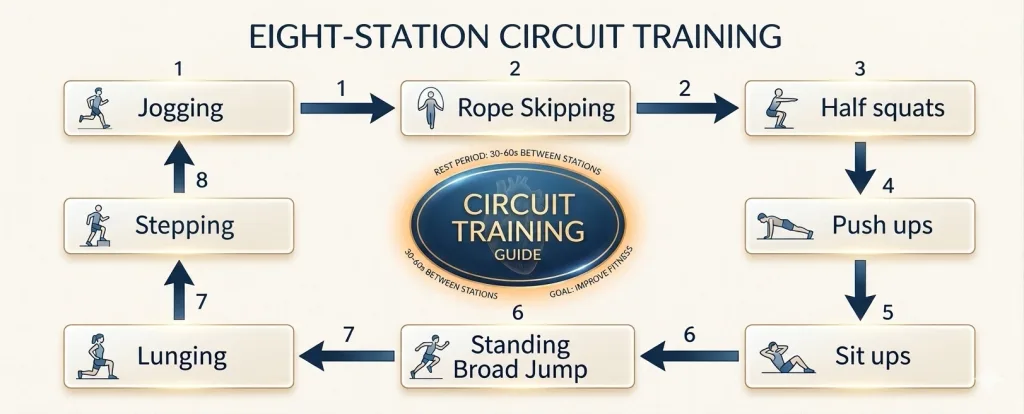
Circuit training is an effective and time efficient workout routine. It is a set of 8-10 circuit exercises all performed with little to no rest in between to complete one circuit. Circuit workout is now made easy with availability of live sessions. At Thrivecore, we include circuit training in our fitness programs where our certified trainers give you a structured routine and guidance at every step. Let us understand the routine in the diagram.
-
- The routine starts with jogging, to warm up your body.
-
- The second is rope skipping, this helps get your heart rate up.
-
- The third is half squats which helps strengthen the lower body.
-
- The fourth is push ups to help strengthen upper body.
-
- The fifth exercise is sit up, an intense exercise to work your core.
-
- The sixth is standing broad jump, tohelp accelerate your heart rate.
-
- The seventh is lunges which helps with enduring balance and leg strength.
-
- The circuit is ended with stepping exercises which helps build stamina.
To complete a full workout keep repeating circuits exercise 4-5 times. This is an ideal circuit exercise because it focuses on working all the body parts while keeping the heart rate up.
Are you looking for a customized fitness plan at an affordable price?
Get a plan tailored to your goals, schedule, and lifestyle — without spending on expensive trainers.
What are the best circuit training exercises for fat loss and strength?
To get the most from your workouts, choose compound movements. These work multiple joints and muscles at once, burning more calories. Here are the top picks:
-
- Squats: Great for legs and glutes. Add an extra jump for extra intensity.
-
- Push-Ups: Works your chest, shoulders, and arms. For beginners, try with knees on the floor.
-
- Lunges: Targets legs and improves balance. You can try reverse or walking lunges to add intensity.
-
- Mountain Climbers: This is a full-body move that increases your heart rate.
-
- Rows (if you have weights): It strengthens your back and improves your posture.
-
- Planks: It builds core stability and protect your lower back.
-
- Jumping Jacks: A classic cardio exercise that gets your blood flowing and keeps your heart rate up.
-
- Glute Bridges: It activates and strengthens your glutes, which helps with knee health.
Mix these circuit exercises in your sessions for a balanced, effective session.
Why is circuit training ideal for a Female Fitness Training Program?
Women have a different set of requirements when it comes to fat loss. The most common reason for weight gain in women is PCOD, or other hormonal imbalances, which require special assistance to reverse the effects and circuit training is one of the best forms of workout for women dealing with these conditions.
It helps with insulin resistance, fat loss, muscle gain, builds bone density and is very adaptable, which is everything you need to recompose your body. A Female Fitness Training Program at THRIVECORE will provide a program tailored just for your needs that fits right in with your lifestyle.
How often should you do circuit training for the best results?
Results from any workouts show up when you are consistent. Doing circuit workouts 2-4 times per week is good enough. This frequency of workouts gives your body enough stimulus to change while allowing time to properly recover.
On your days off, focus on active recovery. Complete 7-10k steps, do gentle yoga, or stretch. This keeps you moving without overtraining. If you feel exhausted or notice your performance is dropping, take an extra rest day. Recovery is when your body actually builds muscle and gets stronger.
What tips can help you get maximum results from circuit training?
Here are a few things you must do to get maximum results from circuit training:
-
- Warm up & stretch: Take time, 5 minutes before workouts to warm up, this helps prepare your muscles and reduce injury. And take 5-10 minutes after workouts to cool down, this helps in better recovery.
-
- Sleep: This is an often-ignored step. People don’t take sleep seriously, but it is very important for men to take 7-8 hours of sleep and for women to take 8-9 hours of sleep on a daily basis for good recovery and functioning of their bodies.
-
- Drink Water: It is essential to stay hydrated. Drinking coffee or energy drinks does not count. Drink at least 3 Liters of water per day for good hydration.
-
- Nutrition: Eating junk food often will not help you achieve your goals. Eat healthy, nutritious food daily. Have 3 meals per day packed with protein and fiber. Fueling your body is as important as fueling your car.
Why are online fitness programs becoming popular for home workouts?
When you are in a space like a gym, you have trainers around to help you with your workout structure and form. Some people do not have time or money to spend on a gym, but when you are at home, you are clueless, you don’t know where to start, especially for beginners.
This is when online fitness programs come to your rescue. Like, we at THRIVECORE understand your needs, we listen to your goals, and help you transform your body at your convenience. You get to choose your own timings, do not need to go somewhere, and you have access to some of the best trainers in the country to help you achieve your goals.
At Thrivecore, we have seen women transform their health through online coaching. They gain strength, lose fat, and feel more confident. And they do it all from home, wearing their favourite leggings, with no judgment.
Circuit Training vs Traditional Gym Workout
Circuit Training:
Faster workouts
Higher calorie burn
Improves stamina
Time efficient
Traditional Gym Training:
Focuses more on muscle building
Requires more time
Longer rest periods
For busy professionals and women managing home and work, circuit training is often the better choice.
Conclusion
Circuit training isn’t about cramming as many viral workout trends as possible into a 10 min session. Nor is the goal to make your body do as many different exercises as it can. It’s about making every movement count. Every exercise has a job to do – whether that’s targeting a weak muscle group, improving endurance, correcting posture or building strength. Nothing is there just to fill in the gaps.
Every circuit exercise earns its place. When the right movements are performed consistently in the right order and with proper form, they deliver results that are specific to your goals. Whether you’re trying to lose weight, build muscle, improve posture or increase stability and endurance, a thoughtfully designed circuit can get you there far more effectively than a random collection of exercises.
The real skill lies in knowing which exercises belong together, which ones deserve more repetitions or intensity and which ones need a gentler approach. ThriveCore’s fitness program is designed keeping this in mind.
Every circuit begins with understanding your body, your goals and your health profile before a routinee is prescribed. Because the most effective circuit isn’t the toughest one – it’s the one that’s built for you and keeps you coming back.
Frequently Asked Questions
1. How effective is circuit training for weight loss?
Yes, it is very effective. Circuit training burns higher calories than any traditional workouts and keeps your metabolism elevated for hours afterwards due to the afterburn effect. This makes it one of the most efficient methods for fat loss.
2. Which is better, circuit training or strength training?
It depends on your goal. If you want to slowly build muscle and get a toned physique, then traditional strength training with heavier weights is better for you. If you want fat loss combined with muscle tone in less time, circuit training is for you.
3. What are the advantages of jumping jacks?
Jumping jacks are a full-body cardio move. They elevate your heart rate, improve coordination, burn lots of calories, and build bone density through impact. They can be done anywhere and do not require any equipment.
4. Does circuit training count as cardio?
Yes, absolutely, it counts as both cardio and strength training. This is because you take little to no rest in between exercises, which keeps your heart rate up throughout the whole session.
5. Is 20 minutes of circuit training enough?
Absolutely. A well-designed 20-minute circuit program can be highly effective, especially if you can do high-intensity workouts. This is perfect for people with busy schedules.
6.Can you do circuit training every day?
Daily circuit training is not recommended. Your muscles need 48 hours to recover and rebuild themselves. 3-4 sessions per week for best results, but not to the point of burnout or injury.
7. Why is circuit training good?
Circuit training combines strength and cardio in one session and burns more calories in less time. It increases cardiovascular fitness, builds muscle, revs up metabolism and keeps workouts interesting; a great way to get fit all over.
8. What is the 5-3-1 rule?
The 5-3-1 rule is a training method where you work out 4 times a week over the course of 4 weeks. Week 1: you do three sets of five reps, then in Week 2: you do 3 sets of three reps, in Week 3: you do three sets of one rep, increasing weight each time. Then in Week 4, you use lighter weights than the previous week and do 5 reps of 3 sets ideally. It is designed to build raw strength rather than endurance.
9. What is the best circuit for beginners?
A great beginner circuit includes: bodyweight squats, modified push-ups, lunges, burpees, jumping jacks, mountain climbers, and plank holds. Rest 60 seconds between circuits and repeat three to four times.
10. What are the pros and cons of circuit training?