
Home >> BMI Calcualtor for Men and Women
Enter your height and weight to get your instant Body Mass Index, checked against WHO categories - then get a free personalised plan recommendation from a certified ThriveCore coach.
Apna poora report email par paayein
A Body Mass Index (BMI) Calculator is an online screening tool that uses two numbers (your height and your weight) to estimate how much body fat you have. It won’t diagnose anything on its own, but it gives you a fast, free starting point to see if your weight is healthy for your height.
The maths is simple. Your weight in kilograms is divided by your height in metres squared. If you are using pounds and inches use the imperial method of the same formula. You then take that number and compare it to fixed weight categories defined by the World Health Organization, which will tell you instantly if you are ‘underweight’, ‘healthy’, ‘overweight’ or ‘obese’.
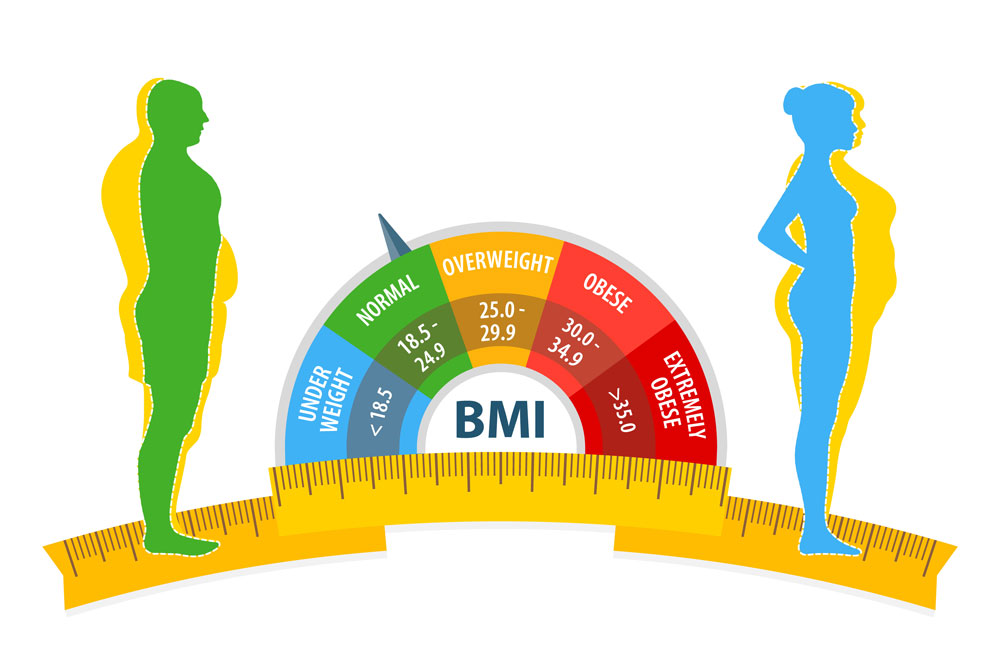
BMI uses the same formula for everyone. There’s no separate calculation for men and women. Height and weight go in, one number comes out. What differs is how that number should be interpreted, since body composition between sexes (and between individuals) can vary even at the same BMI.
You don’t need a calculator to work it out. Here’s how to do it depending on which units you’re using.
Once you have your BMI score, you are put into one of four categories specified by the World Health Organization.
This range could be a sign of low energy reserves and a weaker immune response, and would be worth discussing with your doctor.
At this range, you have a lower risk of health problems associated with your weight.
You are more likely to develop health issues like high blood pressure and type 2 diabetes.
At this range, you have a much higher risk of chronic diseases, including cardiovascular disease.
BMI is useful precisely because it’s simple. That simplicity is also its biggest weakness.
BMI can’t tell the difference between the two. A heavily muscled athlete and someone carrying excess fat can land on the exact same number.
It says nothing about where fat is stored. More fat around your organs (visceral fat) is a bigger health risk than fat stored elsewhere and BMI can’t see that distinction.
Age, bone density, pregnancy, and ethnic variations in body composition all impact how useful a certain BMI score actually is for a single person.
If checked consistently over time, BMI can show you the direction your weight is moving, even if the number isn’t precise.
It’s instant and free. No equipment or appointments required, just two numbers.
A high or low result is a red flag to allow you to look into your health further. But it’s not a diagnosis.
Once you have your BMI score, you are put into one of four categories specified by the World Health Organization.
A range between 18.5 to 24.9 is healthy.. But other factors like blood pressure, waist circumference and muscle mass all have to be taken into account along with BMI.
Kids are growing constantly, so a fixed range doesn’t apply the same way. Pediatric BMI is measured by percentile instead, comparing a child’s BMI to others of the same age and gender. A percentile between the 5th and 85th is generally considered healthy.
Loading related posts...