| Gentle range-of-motion exercises such as shoulder rolls, wall slides and resistance band pull-aparts can help relieve arm pain and improve mobility by decreasing stiffness and improving circulation. Most routines begin with 2-3 sets of light movement 3-4 times a week and should be stopped immediately if sharp pain occurs. |
Quick Summary
Key points you should know before starting arm pain exercises.
- Arm pain is typically the result of overuse, poor posture or stiff joints, not of a serious injury.
- Strengthening usually follows gentle range-of-motion exercises.
- Aim for 3–4 exercise sessions each week for steady improvement.
- Always warm up before stretching to prepare your muscles and joints.
- Once you regain basic mobility, resistance band exercises can safely build strength.
- If pain becomes sharp, shooting, or suddenly worsens, stop exercising immediately.
- If your pain started after an injury, surgery, or an arthritis diagnosis, follow a personalized exercise plan instead of guessing.
Desk work, heavy lifting or aging joints can easily result in tight and sore arms. By dealing with that tightness immediately, you prevent those everyday aches from turning into chronic stiffness, so you can get back to your routine in comfort.
Simple exercises such as shoulder rolls, wall slides and resistance band pull-aparts can help ease arm pain and increase your range of motion. They loosen tight muscles, increase circulation and get your joints moving freely again.
Start to feel better with 2-3 sets of light movement 3-4 times a week. If you have any sharp pain stop immediately and check with a health professional. Always stay in a comfortable range.
This guide will cover some of the common causes, safety tips, 10 effective exercises, how often to do each exercise per day and important warning signs to look for.
What Causes Arm Pain and Stiffness
Everyday movement can irritate, strain or tire muscles, tendons or joints and most often causes arm pain and stiffness. Identify what is causing your pain, whether it is tight muscles, rigid joints or a nerve being pinched, so you can determine the safest and most effective movement pattern for you.
Common Causes: Overuse, Poor Posture, Arthritis
There are many daily habits that can lead to pain in the arms:
- Repetitive Strain: Doing the same activity over and over again, such as typing, heavy lifting or playing sports, can strain muscles and tendons. This constant strain causes tendonitis, inflammation of the tendons around your elbow or shoulder.
- Poor Posture: When you slump or round your shoulders forward you are putting extra stress on your upper body. Tightness in the chest and strain in the back muscles make it difficult to lift your arms easily or to turn them.
- Arthritis: When the cartilage in your joints is wearing away. This can lead to soreness, stiffness and pain in the shoulder, elbow or wrist.
When Arm Pain Signals Something More Serious
Most arm pain is caused by mild muscle tension, but some symptoms need a doctor’s closer look:
- Nerve Compression: A pinched nerve in the neck (cervical radiculopathy) can cause sharp, burning pain, numbness or tingling down your arm. Carpal tunnel syndrome is a compression of the median nerve at the wrist that can cause hand weakness or numbness.
- Frozen Shoulder (Adhesive Capsulitis): This is when the tissues around the shoulder joint become thickened and tight, making it hard for you to lift or turn your arm.
- Severe Injuries: If you have a major problem such as a complete tear of the rotator cuff or a sudden injury, the American Academy of Orthopaedic Surgeons (AAOS) says you should always see a doctor before you begin exercising.
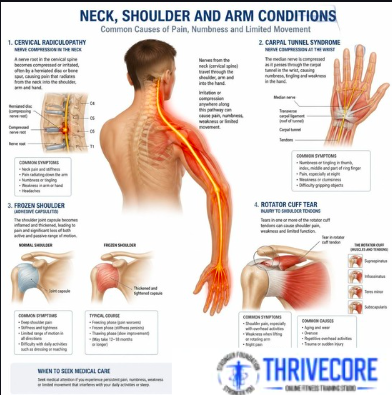
Key Takeaway: Repetitive strain, poor posture or joint wear and tear cause most arm stiffness, but radiating numbness or severe pain should be checked medically before exercising.
Not sure what’s behind your arm pain? Book a Free Consultation.
Is It Safe to Exercise When Your Arm Hurts?
Moving your arm is safe as long as the exercises are simple, do not cause pain and return normal range of motion. If you’re feeling sharp or increasing pain, your body is telling you to rest your arm, not work out.
Knowing the difference between helpful movement and harmful strain will help protect your joints while bringing blood flow to tight spots.
Signs You Should Rest Instead
Rest is good for sudden injury or sudden nerve irritation. If you’re at rest and you feel severe, pounding pain, this generally means your muscles and joints need to rest.
Also, do not exercise if you experience visible swelling, redness, joint instability or sharp shooting sensations when you perform simple tasks.
Signs Gentle Movement May Help
If you experience a dull ache or mild morning stiffness which improves as you move, simple activity is fine. Gentle upper body stretches help with light muscle tightness that relaxes with warmth or slow movement.
| Symptom | Rest Is Recommended | Gentle Movement Is Encouraged |
| Pain Type | Sharp, shooting or severe throbbing | Dull ache, mild tension or stiffness |
| How Pain Started | Sudden onset following injury or fall | Gradual onset from posture or desk work |
| Joint Appearance | Visible swelling, heat or bruising | Normal appearance. No swelling |
| Response to Motion | Pain radiating down the arm or worsening | Not so stiff or rigid & easier to move |
Key Takeaway: If you have a sudden pain, or if your body part is swollen or hurt, you should rest. If your muscles are tight and tense most of the time, try some simple mobility exercises.
How Can Exercise Improve Arm Mobility?
Arm mobility exercises keep the blood flowing. It is good for relaxing muscles and increasing co-ordination of the brain and muscles. The arm tissue does not get tight and remains flexible with light movement.
These exercises can help to relieve symptoms of stiff arms and keep your joints and tendons loose. Controlled movements allow you to get back your natural movement in your arm after some rest or stiffness.
If you’re not sure where to begin, a mobility assessment will reveal the tight spots so you can move well without adding more strain to your body.
Key Takeaway: When done properly, range-of-motion exercises lubricate your joints, stretch tight muscles, and restore motion to your arm.
Which Exercises Are Best for Arm Pain Relief?
The best way to get arm pain relief is through controlled stretching and light activation of your shoulders, chest, forearms and upper back. These are a safe way to relieve tension without overstressing sensitive areas.
All of these 10 exercises follow guidelines reviewed by certified trainers and physiotherapists.
| ⚠️Safety TipsTake each step slow and smooth. Don’t jump or reach too far.Stay in a range that feels good to you, don’t go above or below it. If you feel sharp pain, stop immediately. Take a short walk or warm shower to prepare your body to stretch. |
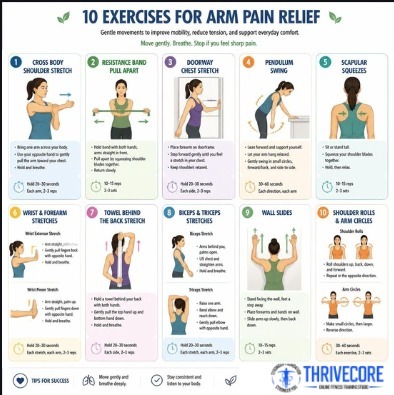
Shoulder Rolls and Arm Circles
Helps keep your joints flexible and your shoulders less stiff.
- Stand or sit straight with your arms hanging at your sides.
- Roll your shoulders up towards your ears, back and then down.
- Do 10 backwards rolls followed by 10 forward rolls.
- Move your arms out to the sides and make small, steady circles in the air 10 times in each direction.
Wall Slides
This will help loosen up tight shoulders and make it easier to reach up and grab something.
- Stand with your back against a wall, feet about 6 inches apart.
- Place your arms flat on the wall, elbows bent 90 degrees.
- Slide your forearms up the wall, slowly, without shrugging as high as you can reach.
- Take a little break, then slide back down. Do it 8 to 10 times.
Cross-Body Shoulder Stretch
This stretch can loosen up deep tension in the back of your shoulder.
- Stand up and put one arm out across your chest in front of you, at shoulder height.
- Extend your arm away from your body and hold it above your elbow. Slowly pull your arm towards your chest until you feel a mild stretch.
- Hold for 20 to 30 seconds while continuing to breathe normally.
- Slowly release and repeat with the other arm. Do 3 sets on each side.
Resistance Band Pull-Aparts
It’s a great exercise to strengthen your upper back and fix your slumped posture.
- Stand with your feet hip-width apart and holding a light resistance band in front of you at shoulder height.
- Straighten your arms out and bend your elbows a bit.
- Pull the band apart until it touches your chest squeezing your shoulder blades together.
- Slowly return back to your starting point. Do two sets of 10 to 12 reps.
Wrist and Forearm Stretches
This is good if you are typing for long periods of time and your forearms start to ache and feel tight.
- The first thing you do is put one arm out in front of you, straight, palm down.
- With your other hand, pull your fingers towards you until you feel a good stretch in your forearm.
- Hold for 20 seconds, then turn your palm up and back, and gently push back with the back of your hand.
- Repeat this two or three times on each arm.
Doorway Chest Stretch
It opens tight chest muscles, and pulls rounded shoulders back.
- Stand in an open doorway with your elbows bent at a 90-degree angle to the door frame.
- Gently take a step forward with one foot, until you feel a nice stretch in your chest.
- Keep your head up, don’t arch your back.
- Hold 20 to 30 seconds, step back and repeat 3 more times.
Pendulum Swing
This movement is good for loosening up a stiff shoulder joint without overstraining the muscles around it.
- First, lean forward a little and rest your strong arm on a table or chair.
- Let your sore arm hang straight down to the floor and relax it.
- Rotate your body gently so that the hanging arm makes small circles.
- Draw 10 small circles clockwise and then 10 circles anti-clockwise.
Towel Behind-the-Back Stretch
Try this stretch if it feels tight or stiff to reach behind your back.
- Hold a small hand towel in one hand and drop it behind your back.
- Bring your other hand behind your low back and grab the bottom of the towel.
- Pull the towel up slowly with your good hand until you feel a small stretch in your lower arm.
- Hold for 15 to 20 seconds and then switch sides. Do it two or three times.
Bicep and Tricep Stretches
Really helps loosen arm muscles that get tight from bending, lifting heavy objects
- Reach down to your upper back with one arm extended over your head. Bend your elbow.
- Apply gentle pressure to your elbow with your other hand. Leave on for 20 seconds.
- Stand sideways to a wall with your hand flat against the wall, thumb pointing up, then slowly turn your body away from the wall.
- Hold each stretch for 20 seconds and repeat two to three times on each side.
Scapular Squeezes
Good for upper back and relieving strain on arms due to bad posture.
- Sit or stand up straight with your arms at your sides.
- Squeeze your shoulder blades together and down towards your spine.
- Don’t shrug your shoulders for 5 seconds, while you are holding the squeeze.
- Release slowly, repeat 10-12 times.
Practical Example: At a desk all day? Doing wall slides and scapular squeezes daily can help to release upper body tension and improve your ability to move your arms overhead over time.
Key Takeaway: A combination of gentle mobility exercises, chest stretches and back strengthening exercises will allow you to safely relax tight arm muscles.
Looking for a workout that’s right for your body? Work with a professional to build your personalized fitness plan.
How Often Should You Do Arm Mobility Exercises?
Do gentle arm mobility exercises 3-4 times per week to help with your arm’s range of motion. Doing two or three sets of these light moves each time is a good way to get more flexible without a lot of stress on your joints. If it doesn’t hurt, you can do some light stretching most days of the week.
If you’re just beginning, don’t try to do too much at once. Just stick to being consistent. You can exercise for 10 to 15 minutes at a time to get your muscles and joints accustomed to it.
Once you start to feel a little less stiff and more flexible you can add resistance bands. Stick to light ones in the beginning. Take your time. And take a day off each week to rest your muscles so they heal properly.
Key Takeaway: The optimal number of sessions to do is 3 to 4 per week. Consistency beats intensity every time.
Can Exercise Help with Arthritis-Related Arm Pain?
Gentle exercises for the arms really help in easing the pain of arthritis by improving the range of motion. They keep the joint from getting stiff and build up the muscles around the joint. Even small movements help lubricate your joints, and stiffness in the morning gets better.
In fact, the National Institute of Arthritis and Musculoskeletal and Skin Diseases (NIAMS) says that if you have osteoarthritis or rheumatoid arthritis, it’s important to stay active to help your joints move well. Low-impact movements are easier on your joints and help you prevent muscle loss around your shoulders and elbows.
The American College of Sports Medicine (ACSM) also suggests performing flexibility and range-of-motion exercises at least 2 to 3 days per week to help keep your muscles flexible and to support joint function.
If you’re having an arthritis flare-up, keep your movements soft and easy. Focus on activities that are low resistance and slow range of motion. An arthritis exercise program keeps you active and safe without hurting sore joints.
Key Takeaway: The best way to manage arthritis is consistent gentle movement. Daily light-moderate exercise builds up your muscles and joints.
What Mistakes Should You Avoid When Stretching a Painful Arm?
If you make a few common mistakes, stretching can do more harm than good. Be on the lookout for these:
- Forcing movement: If it hurts, stop. If a painful joint does not respond it is not always better to push it too far as this can stress the soft tissue around it.
- Bouncing: Don’t bounce when you stretch. It may seem like it will help you go further, but it actually tightens your muscles instead of loosening them.
- Holding your breath: When you hold your breath, your body stays tense. As you sink into a stretch, remember to breathe out slowly.
- Skipping a warm-up: Warming up is important as it’ll help your muscles stretch better. Do some shoulder rolls or take a warm shower first before you do static stretches.
Key Takeaway: Take it slow, breathe deeply and stay within pain free ranges so that your arm muscles are protected.
When Should You See a Doctor for Arm Pain?
If you are suddenly in pain after you had an injury or a fall, or if you also have swelling, severe weakness or a fever, then you should see a doctor right away. Trying to work out when bones are broken or tissues are torn can delay healing.
According to the NHS, if your arm is very painful and stiff, or if your joint is swollen and you have a fever or hot skin, see a doctor. These may be signs of an infection.
Red Flags: When to See a Doctor
Some symptoms shouldn’t wait. If you notice any of these, get checked out right away:
- Pain or soreness after a fall or injury.
- An arm that looks bent, swollen, or just “off”.
- Sudden numbness or losing feeling in your fingers or hands.
- Severe swelling of the joints, and warmth, fever or redness.
- Pain in your arms along with pressure in the chest, shortness of breath or dizziness.
Key Takeaway: Seek immediate care right away for a sudden injury or numbness of nerves or arm pain with chest pain.
How Does ThriveCore Support Arm Pain and Mobility Recovery?
If you have arm pain, you can get better, faster if you know what to do next. ThriveCore connects you to a professional who’s with you at each step to help you move safely.
The first step is a full assessment to see what your limits are, how you move and where you feel restricted. Then you receive your personalised fitness plan tailored to your everyday life.
We guide you through a series of exercise progressions, helping you to get stronger and more flexible without risking extra strain.
Frequently Asked Questions
Q1. What exercises help relieve arm pain fast?
Slow shoulder rolls and wall slides are simple stretches to help quickly relieve tension. But for long lasting relief, you need to do a regular routine every day and not just a one off exercise.
Q2. Can I exercise if my arm hurts?
Light range-of-motion movements are generally fine, but if you begin to feel sharp or shooting pain that worsens, that’s a signal to stop and consult a doctor.
Q3. How long does arm mobility take to improve?
In 2-3 weeks of consistent, gentle training many people feel less stiff. But full mobility recovery can be longer depending on the underlying cause.
Q4. What causes stiffness in the arm?
The common causes of arm stiffness is overusing, poor posture, continuous inactivity or joint conditions like arthritis.
Q5. Are resistance bands good for arm pain?
Yes, using light resistance bands is good for rebuilding strength around the joint. These exercises are typically introduced as pain and basic mobility improves.
Q6. Can poor posture cause arm pain?
Yes. Long periods of sitting in a forward hunch can strain the shoulder and upper arm muscles leading to discomfort and pain.
Q7. What is frozen shoulder and how is it related to arm pain?
Frozen shoulder or adhesive capsulitis, is a condition where the shoulder joint becomes stiff and moving it becomes difficult. Usually it causes arm pain and your range of motion is reduced.
Q8. Should I stretch a sore arm every day?
Light stretching every day is usually fine. But you need to build in days of rest so that your muscles and joints will recover.
Q9. Can arm exercises help carpal tunnel symptoms?
If your pain is mild, try exercises for your wrist and forearm to help ease it. If you have continuing numbness or tingling, see a doctor.
Q10. Is it normal to have sore arms after stretching?
Mild soreness for a day or two is common after starting a new exercise routine. But sharp or long lasting pain is not. You should get it checked by a professional.
Q11. Can arthritis in the arm be managed with exercise?
Many people managing arthritis are advised to include gentle range-of-motion exercises as part of a safe arthritis fitness, along with medical guidance.
Q12. What’s the difference between stretching and strengthening for arm pain?
The purpose of stretching is to decrease stiffness and increase range of motion. Strengthening helps to build muscles which support the joint in the longer run.
Q13. How do I know if my arm pain needs a doctor?
Sudden or severe pain, numbness, swelling or pain after an injury are reasons to consult a doctor instead of treating yourself with exercise alone.
Q14. Can typing or desk work cause arm pain?
Yes, repetitive strain from typing and mouse use is a common contributor to wrist, forearm and shoulder discomfort.
Q15. What is the best exercise for shoulder and arm mobility?
Wall slides and pendulum swings are often recommended as gentle low-risk ways to work on shoulder and arm mobility.
Q16. Should older adults do arm mobility exercises differently?
Older adults may progress slower and use lighter resistance preferably with a certified trainer that understands age related changes to the joints.
Q17. Kya roz arm stretching karne se dard kam ho sakta hai?
Haan, agar roz halka stretching kare sahi tarike se toh stiffness aur dard mein farak dikhta hai. Bas dard zyada ho ya na jaaye toh doctor ko dikha lena, phir stretching continue karna.
Q18. Can arm pain be related to neck problems?
Yes, nerve compression in the neck can sometimes radiate pain down the arm. A medical evaluation should always be done if you have persistent arm pain with neck symptoms.
Q19. Do I need equipment to improve arm mobility at home?
No you don’t need any equipment. There are plenty of mobility exercises that you can do with just your body weight or a resistance band, so they’re easy to get started on at home.
Q20. How does ThriveCore help with arm pain and mobility recovery?
The first thing we do is test your mobility, how far can you go. Then we’ll help you put together a customized fitness plan that lets you progress safely at your own pace.
Begin Your Online Fitness Journey with ThriveCore Today.