Most fitness platforms are built to sell subscriptions, not outcomes. They hand every member the same twelve-week plan regardless of age, injury history, or lifestyle, and hope enough people stick around for it to look like it worked. ThriveCore was built the opposite way around: a coach sits with your health profile first, and the plan is written to fit you — not the other way around.
That means the exercises you get in week one may look nothing like the exercises another member with a different history gets in the same week, even on the same track. It also means your plan changes as you do — a session that felt hard in March should feel manageable by June, and your coach adjusts the loading accordingly instead of leaving you to plateau on autopilot.
ThriveCore was never built to be a one-size-fits-all fitness app. Every plan starts with your health history, your current limitations, and your real-world schedule — then a coach builds around it.
Rebuilding strength you feel slipping — stairs, luggage, getting up off the floor without thinking twice.
Navigating PCOS, PCOD, perimenopause or menopause and want training that works with your body, not against it.
Rebuilding core and pelvic floor strength safely after pregnancy, at your own pace, with a coach who understands the stages.
Limited time, frequent travel, unpredictable schedules — and a program that flexes around all of it.
Training around arthritis, joint pain or diabetes with a coach who adapts every session to what your body can handle that day.
Focused on the functional strength that keeps independence — balance, mobility, and confidence in daily movement.
Coming back after an injury, illness, or simply years away from structured exercise, without re-injuring yourself.
Training history already in place and looking for real periodisation and visible physique progress, not guesswork.
Every track, from Foundation to Performance, starts from the same baseline of coaching support. What changes between tracks is the intensity and complexity of the training itself — never the level of attention you get.
Most people don't chase strength training for the way it looks — they come to us because daily life has started to feel harder than it should. Here's what members consistently tell us changes first.
Progressive resistance training is one of the few interventions proven to slow bone density loss and reinforce the connective tissue around your joints — the exact areas that start to complain first after 40.
Members consistently report less afternoon fatigue and more stamina for stairs, travel and long days — not from cardio alone, but from a body that's simply stronger at rest.
Functional strength patterns — hinging, squatting, carrying, pushing — are trained deliberately so ordinary movements like lifting a suitcase stop being a source of dread.
Resistance training improves insulin sensitivity and supports healthier hormone regulation — particularly valuable for PCOS, PCOD, and the metabolic shifts of perimenopause.
A dedicated core and back-strengthening focus corrects the slouch that builds up from desks and screens — and confidence tends to follow strength almost automatically.
The strength to carry groceries, play with grandchildren, or get off the floor unassisted is entirely trainable — it just needs to be trained on purpose, consistently.
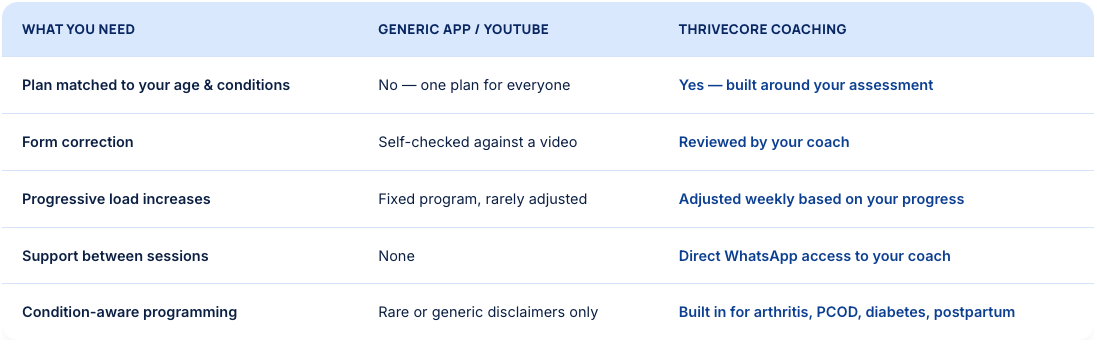
Generic fitness apps and pre-recorded videos have no idea about your knee surgery, your PCOS diagnosis, or the back spasm you had last week. Here's the honest comparison.
Doctors recommend resistance training because it helps protect your body from illness and keeps you capable as you age. Lifting weights helps your body absorb glucose from your blood more effectively, which is why the IDF Physical Activity Guidelines and the American Diabetes Association point to strength training as a tool for managing conditions like type 2 diabetes — and just two sessions a week is enough to matter.
Muscle mass and bone density both decline with age unless something actively works against that decline. Lifting weights builds denser bone and tougher muscle, signalling your body to hold onto the strength it would otherwise start losing over time.
The American College of Sports Medicine (ACSM) notes that strength training protects your joints and improves balance, reducing fall risk — which is exactly why physiotherapists and physicians recommend it alongside other treatment, not as a replacement for it.
The catch is that resistance training done poorly — too much weight, too soon, with no attention to your individual limitations — can do more harm than good. That's the entire reason a coach sits between you and the exercise itself: not to make the workout harder, but to make sure the weight, the form and the pace are actually right for your body on that particular day.
Your coach places you on the right track after your free assessment — and moves you forward as your strength, confidence and consistency grow.
For absolute beginners, older adults, or anyone returning post-injury.
For members with some training history seeking steady, structured progression.
For experienced members targeting visible strength and physique results.
Every ThriveCore member gets a simple, running record of the numbers that actually predict long-term strength: load lifted, reps completed, movement quality on video, and how sessions feel on a 1–10 effort scale. Your coach reviews this weekly and uses it to decide exactly what changes next — more weight, more reps, more rest, or a different exercise altogether.
Every set, rep and weight is logged, so progression is a decision backed by data — not a guess about whether you're ready to add more.
Send a short clip of any lift and your coach reviews it directly — catching the small technique drifts that cause most avoidable injuries.
A recurring check-in against your original assessment — strength gained, pain reduced, energy improved — so progress is visible, not assumed.
No guesswork, no wasted time. Every ThriveCore session follows a coach-designed structure that warms your body up properly and leaves nothing to chance.
Joint mobility and muscle activation drills that prepare your body for load and reduce injury risk.
3–5 core compound exercises — squats, hinges, presses, pulls — the true engine of the session.
Targeted work for smaller muscle groups that support posture, balance and joint stability.
Stretching and breathing work that aids recovery and lowers heart rate before you're back to your day.

ThriveCore's programming is led by Akanksha Mathur, a K11-certified strength coach who founded the program in Pune with one belief: strength training should be prescribed as carefully as medicine, not templated like a generic workout plan.
Her team of 10+ coaches is trained specifically in working around real-world limitations — post-injury clients, PCOS and menopause-related training, arthritis and joint pain, and clients managing diabetes or recovering after surgery. Every coach reviews your intake, your video form checks, and adjusts your plan personally, every week.
This is deliberately not a celebrity-endorsed program you never hear from again after signup — it's a working coaching team you can message on WhatsApp when something doesn't feel right, and hear back from within hours.
Every ThriveCore track includes optional, condition-aware nutrition guidance — not a rigid meal plan, but a framework your coach adjusts alongside your training.
It's usually one of these six mistakes — and a coach watching your plan catches every one of them before it becomes an injury or a dropout.